
Our Stance on Net-Zero
Why Net-Zero?
The Climate Crisis and 1.5 °C
We are in a climate crisis because there are too many GHGs being emitted into our atmosphere, trapping heat and raising our global temperatures. It is the international scientific consensus that, to prevent the worst harms of the climate crisis, we must limit warming to 1.5 degrees Celsius above pre-industrial levels by 2030.

Net-Zero
To avoid warming of 1.5 ℃, we have to rapidly reduce human-related emissions and achieve net-zero as soon as possible. To go ‘net-zero’ means reducing the amount of human-related emissions we produce to as low as possible and balancing the remaining emissions that we can’t reduce by removing them.
We cannot emphasize this enough - we must prioritize adapting the ways we live and working to reduce as many of our emissions as possible. Adapting to reduce emissions at the source must be prioritized over initiatives to remove emissions.
Transitioning to a climate-resilient future through net-zero strategies requires a complete transformation of our energy, transportation, production, and consumption systems. This is necessary to avert the worst consequences of climate change.
There are many different ways we can reduce and remove GHGs. These are the important “green skills” that we want Canadian students to understand and experience. It’s important to empower students with these skills so they can be responsible energy consumers and leaders in the transition to a climate resilient society, economy, and planet that needs to happen N:OW.
Net-Zero: An Imperfect Solution
Net-zero refers to the balance between the amount of GHGs we produce and emit into the atmosphere and the amount that we remove from it. When we reach a point where we are adding less emissions than what we are taking away, we reach net-zero. This can be achieved through a combination of emission reduction and emission removal.
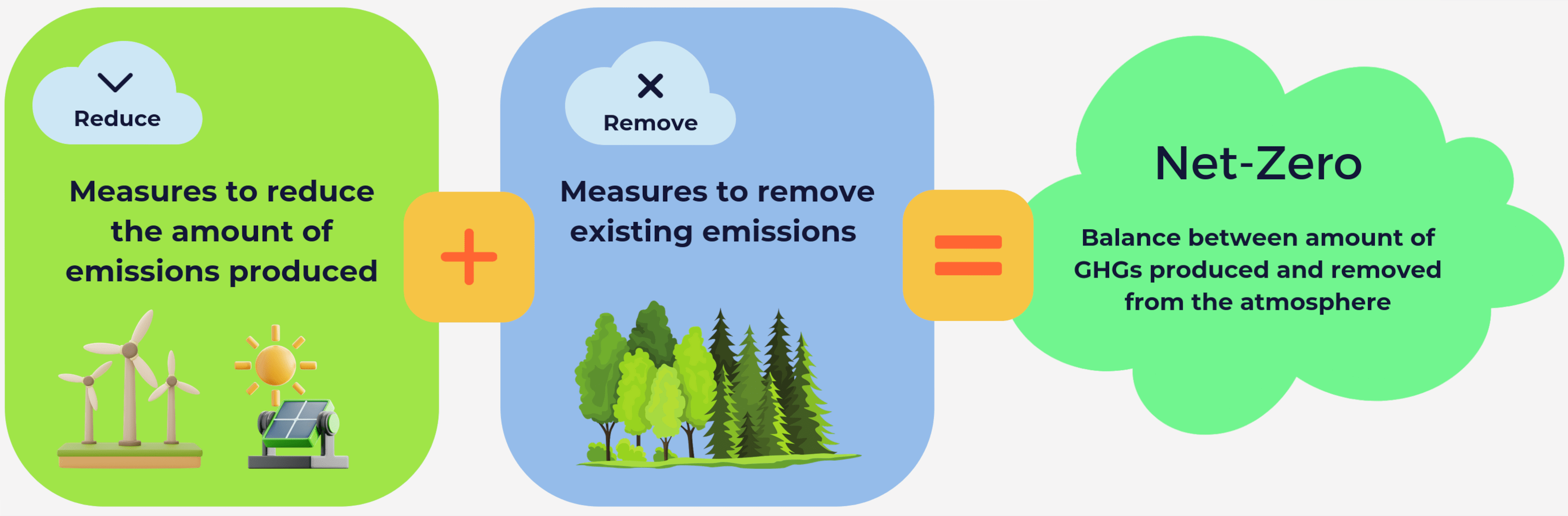
If a school were to install solar panels, they would be adapting the way they power their school. Renewable energy, like solar, produces significantly less GHGs than non-renewable energy from fossil fuels.
If a school knows what its carbon footprint is, they can pay to plant enough trees that will naturally absorb (or “remove”) the amount of carbon and greenhouse gases they emit.
Greenwashing Net-Zero
We can’t buy our way out of the climate crisis
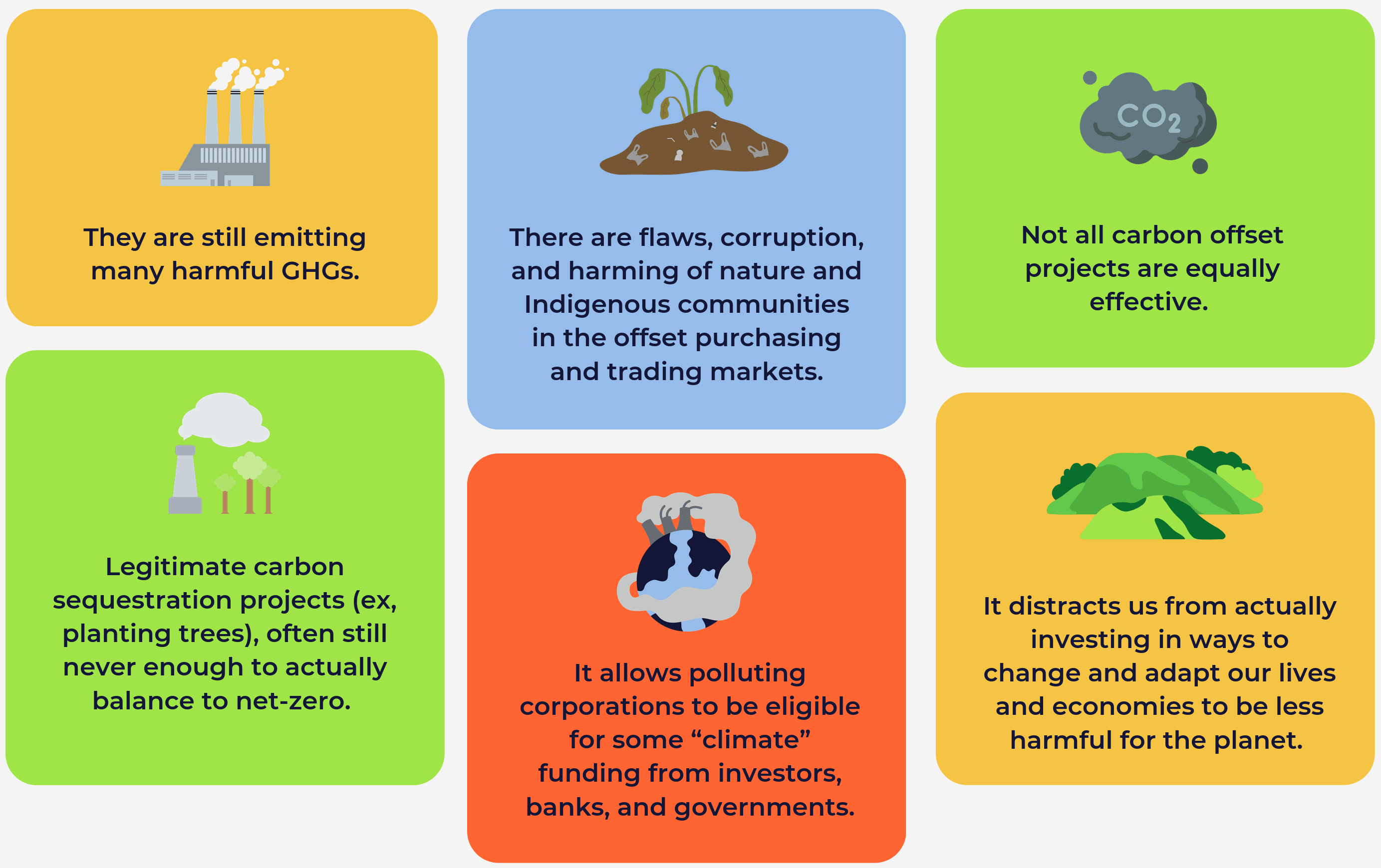
We are seeing the term “net-zero” greenwashed by corporations, institutions, and individuals for personal and capitalistic interest. Sometimes the word is used as a lie, sometimes it's an empty pledge, and sometimes it's a way to avoid the real issue and continue the harmful ways we operate. For governments and corporations that are responsible for emitting many harmful GHGs, the concept of net-zero opens up a loophole for them to exploit.
Instead of having to change the way they operate or stop their practices that are emitting GHGs, they instead can just focus on buying “offsets”. They can buy/pay for projects that reduce, avoid, or remove emissions elsewhere.
There are a few key problems with this:
At N:OW for Net-Zero, we want to call out this behaviour. Simultaneously, we want to acknowledge the pros and cons to the concept of net-zero and the practical ways it’s being applied to our lives, economies, and politics. But, most importantly of all, we want Canadian youth and communities to understand this nuance so that they know which values to ground themselves in when they pursue their own climate action and pathways to net-zero.
Achieving Net-Zero
We believe the path to achieving Net-Zero should be:

FAIR
FAIR
The current state of our environment has repercussions for everyone, but climate change has and will more severely impact youth and marginalized communities. It is important to recognize this inequity and ensure that we are pursuing solutions that restore a healthy planet for everyone, not just those that can afford to buy their own access to safety, clean air, clean water, and food. It is essential that we include and amplify marginalized voices in our solutions-building processes to ensure that they are solutions that work for and protect everyone.
ACCOUNTABLE
Accountable
We know that the concept of “net-zero” is being greenwashed. We know that some net-zero commitments are often making false, empty, or misleading promises. But, we also know that a lot of amazing and impactful emissions reducing initiatives have been fostered and brought to life in the name of net-zero too. We need to advocate for more transparency and accountability across all net-zero initiatives. We demand that net-zero commitments and pledges are backed with scientific facts and metrics to demonstrate real emissions reductions. Additionally, it’s important that communities have the critical thinking skills to assess “net-zero solutions” and whether or not they actually address the root causes of emissions instead of perpetuating the same problems that got us into this climate crisis.
To mobilize ACCOUNTABLE pathways, we require all Funding for Net-Zero applicants to clearly state the metrics they will use to evaluate the impact of their projects. We work with grantees to track progress on these metrics to keep them aligned with their emissions reduction goals. Additionally, we offer comprehensive resources in Curriculum for Net-Zero, designed to spark critical thinking and offer opportunities to explore the most practical and impactful approaches to achieving net-zero.
Collaborative
COLLABORATIVE
The key to building solutions that work—and work for everyone—is collaboration and partnerships. Achieving net-zero is a challenge that calls for adapting our environments, energy systems, buildings, finances, and community practices. It is impossible to be an expert in all of these things, so it is absolutely necessary to connect and find partners to strengthen efforts and more efficiently navigate the challenges and mistakes that are bound to happen along the way. It is important to remember that we don’t have to always reinvent the wheel when it comes to climate action. We can share information with one another about how a certain solution worked or didn’t work to make our collective progress towards net-zero significantly more effective.
To mobilize COLLABORATIVE pathways, we curate the Solutions for Net-Zero library where we publish the stories of youth-led net-zero projects. By capturing and sharing the project stories, we’re able to provide inspiration, ideas, and lessons learned for other communities who might be exploring where and how to start on net-zero initiatives in their own schools. We also support each grantee by researching and connecting them with partners in their communities that might be able to support their work.
